
Introducing chicks to your flock
---------------------------------------------------------
Getting baby chicks can be such an exciting time! You want to believe your older girls will accept the babies and be good “mother hens”, but this is not the case. Your older flock is likely to not share your excitement about these new little pests eating their food and stealing their treats. You need to ease the flock into accepting the chicks by giving them plenty of time to get used to the idea. It’s important to keep the chicks safe because an adult chicken can easily kill a baby.
You should NOT try to introduce a single chick to your flock of older chickens. You need to at least provide the new chick with one friendly face to run to. If you only have one chick, she will become a target for bullies and the more she is bullied, the more others are likely to join in. If you have just a single chick, I would recommend you wait to start to introduce her until she is nearly full grown (around 14-15 weeks). You can read more about introducing a single adult hen here

Wait until chicks are at a minimum 4 weeks old to begin introductions, but 6 weeks would be better. The younger the chicks, the longer you are going to want to draw out the introduction period. Ideally, by the time you mix the flocks permanently, the chicks will be bigger and fully feathered out (around 10-12 weeks).
Introductions Step 1
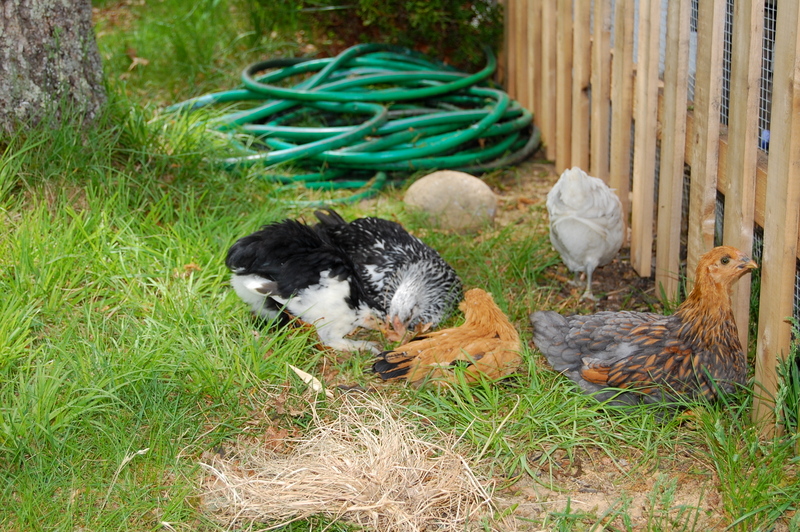
The chicks will need an outdoor space next to the older flock, but separated by wire. The idea is to let everyone see & smell each other, but they can not touch each other. You can do this by dividing off part of your chicken area with wire. If you set up the chick space in your run, remember they will need a secure place to sleep. Click here to see how I built a spare coop for $2 that we could easily bring into the run when needed.
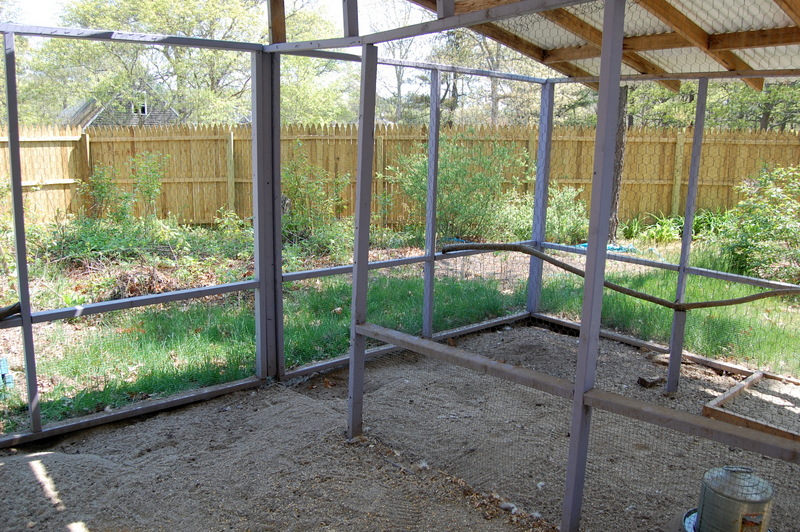
Instead of a second temporary coop, you can also section off part of your main coop for the babies. Now that we have a very large chicken barn, we just set up a wire rabbit exercise run inside of the chicken barn. The wire run is 87 inches by 41 inches. It has plenty of space for growing chickens and has a wire roof to prevent the older girls from jumping in. The grow out chicks can live here until they are ready to join the flock. Don’t forget the food & water for the babies, they will still need chick starter food until they are about 16 weeks old.

Let them live side by side but separated like this for at least two weeks, or until the younger chicks are at least 10 weeks old. If you moved the chicks to the transition space at 4 weeks, they will have to live there for 6 weeks.
Introductions Step 2
When the chicks are 10 weeks old, it’s time to join the main flock! Start by letting everyone out to free range together. Free ranging gives the little ones room to run away from a bully and it is also more neutral ground so the older chickens might not feel so defensive about sharing it.
Introductions Step 3
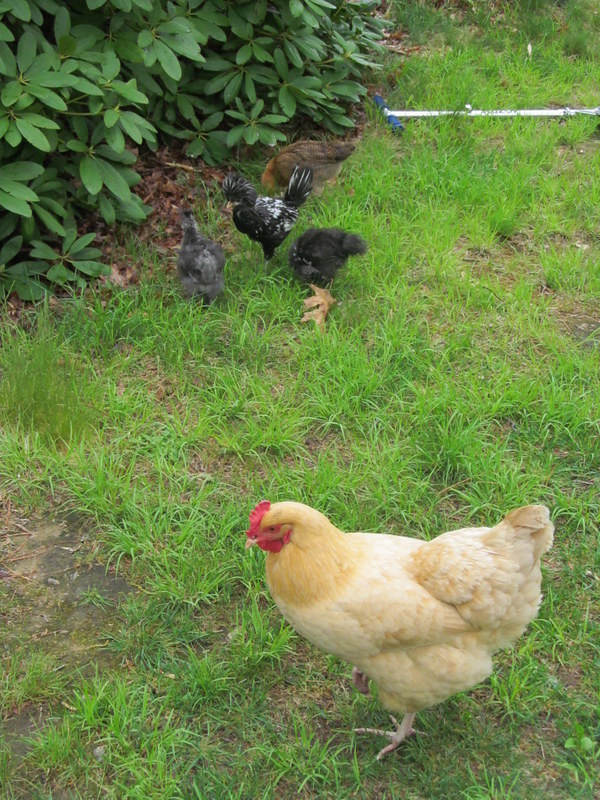
If free ranging goes alright for a couple days, take down the partition during the day. Continue to keep the chicks separated at night. At this point, you are going to need to switch the entire flock over to the chick’s grower feed. See the bag for manufacturer’s age instructions, but generally a young chicken needs to be on starter/grower feed until about 16 weeks in age (when they get ready to lay their first egg). Feeding chicks layer feed is not good because their kidneys can’t process all the calcium. So until the chicks are at laying age, everyone needs to be eating chick feed. It won’t hurt your big girls to be on chick feed, but they will need extra calcium for egg production. Providing a bowl of crushed oyster shells near the feed dish is a great supplement.
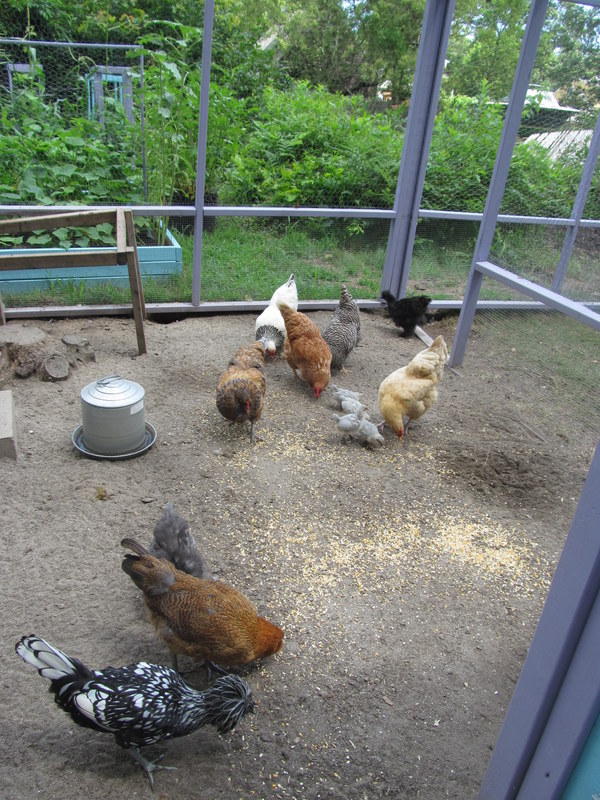
Introductions Step 4
After a week or so of daytime interacting it is time to fully mix the flocks! Remove the chick’s coop or take down the coop partition and keep your fingers crossed. You will need to be on hand the first couple nights to make sure all the chicks find their way into the main coop & roosts at night, but hopefully they will just follow the older chickens in.
Keep an eye on things for the next week and try to let them out as early as possible in the morning. If any of the chickens are injured or bleeding remove them immediately. Keep the injured bird in isolation until she is healed.





I have one adult hen and 7 two-week-old chicks. The hen is brooding and could be hatching a couple more chicks within the next week. When is the best time to introduce my chicks to her? I see the article is about multiple hens but I only have the one hen (a neighbor’s rooster is responsible for “impregnating” my hen).
If the adult hen is brooding, she isn’t going to get off her nest for about 3 weeks and then will be busy tending to new babies for awhile after so she might just leave the little ones alone. On the other hand if the chicks are pestering her all the time, she could go into protection mode and seriously injure one of the chicks. I would still wait until the chicks are at least a month old to start introducing them, and then keep an eye on momma hen to make sure she isn’t being overly protective
Do you think if chicks are under 4 weeks then introduce new chicks this seperation still applies?
It really depends on the chicks. I would try it out, I think they will likely be fine with it. Just be ready to separate them for a week or two if the bigger ones are picking on the little ones
I have two 12 week old chicks and three 6 week old chicks . As well as a 6 hens and 1 rooster (all a little over a year old) all are currently separated based on age. Can we go ahead and put the 6 & 12 week olds together? And then slowly mix those 5 with the other 7?
You might want to give them a day or two living separate by next to each other, but yes I would start by introducing the two younger flocks to each other. Then once they are getting along well you can introduce all the littles to the adults
I have put the baby chicks in with the big girls after free ranging during the da y for a week. How ever in the run they all get along. But I can’t get the chicks to go in a night with the big girls. they stay on the perches in the run. We’ve went out and put them in the coop and they stay .But I’m not going to go out when there 4 feet of snow and do that. Any suggestions?
They will catch on long before the snow comes! Keep going out there at night and locking them in the coop – after a couple weeks they will figure it out!
We have one rooster with our flock. Does that change the timing of when or how we should integrate the chicks? Our chicks are now six weeks old and have lived across a gate from the rest of the flock for a couple of weeks now. The rooster will watch them through the gate and seems quite interested in them. The hens seem less so.
It really depends on your rooster. Some roosters are chill with having chicks around, some will literally kill them on sight. Just to be safe, with a rooster in the mix I would wait a few more weeks to integrate them so the chicks can get a little bigger. And then keep a close eye on the rooster for the first few days when you mix them together
I was gifted a mama hen and her 8 chicks. I fell in love with another chick at the feed store and brought her home. Should I try to slip her under mama or introduce her slowly to the flock? Would introductions be different since Mama hen is the only adult bird I have? The chicks are all about the same age (3ish weeks).
You can try to slip the new one in and see what happens. I have given broody hens chicks that they didn’t hatch lots of times and have not had one reject a chick yet, but where this hen already has had her chicks for 3 weeks she could get defensive. Keep an eye on it and be prepared to have to keep the chick in a brooder if she rejects it, but if I had to guess I’d say the hen will probably accept the new chick just fine.
I have a broody hybrid hen, and have purchased some fertilised eggs to let her sit on (not yet received though). However, today, she has decided not to sit on her golf ball egg replacement. Now I’m worried that I need to get an incubator and brooder in case she abandons the fertilised eggs. I was trying to avoid this route. If I incubate the eggs, is it possible to put the chicks in with her at night? Although she probably won’t be in the nest box? Should I wait a while to try get her to adopt the chicks? Any suggestions? Thank you!
Broody hens can be a mystery sometimes! They seem so devoted then right when you get them eggs they change their mind lol. You should probably have an incubator on hand. Definitely try to encourage her- keep the golf balls eggs and maybe even give her a smaller pen around the nest box if possible to encourage her to stay put. Make the box as enticing as possible with lots of straw or shavings, maybe even add some curtains so it’s more private. I have taken day old chicks several times and given them to broody hens and they all took them no problem. But they have to be broody and the chicks need to be just a day or two old or its unlikely they will just adopt them. Fingers crossed your eggs get here soon and she stays broody!
I have a broody hen separated with two chicks. It’s been about two weeks since they hatched. I have them separated inside the coop without access to the enclosure area. It’s been fine, but now mama hen wants out. I’m worried the chicks are too young. I have two other hens and one has shown aggression when they were fist born but nothing since. Should I just let them out and see what happens? If so, is there a better time of day to do this? Such as after they eat or later in the day? Or, should I just let mama henout and get a warmer for the chicks?
I have always let the moms out with the flock with the babies. For the most part the others just ignored the babies and if any looked at them funny or took a swipe at a chick the mom would step in. I would say let them all out and see how it goes. At 2 weeks they will be fine if someone takes a peck at them as long as it’s not a prolonged series of pecks or aggressive chasing. After you let the other girls out in the morning and they have eaten and got that initial “I’m free!” energy out I would release the new family and be nearby for at least an hour in case you have to step in. Good luck!
I also have a broody hen separated in an elevated nesting box sitting on three eggs. It hasn’t been a week yet but I’m trying to get organized. We have 11 hens and a rooster. At 2 weeks should I also let the mom out with her chicks and just move them to a nest (or make one) on the floor of the coop? I was going to put chicken wire on the box at 19 days to ensure they are fully enclosed. The above scenario didn’t mention a rooster in the mix so wanted your thoughts. They’re literally in the coop and hens will nest on both sides of her after the chicks are born so they’ll know they are there. Also after they are born do I provide that grower feed in the enclosed box for those first two weeks? Thanks!
Hi Christine! I think you would find my article on hatching eggs with a broody hen interesting: https://www.thecapecoop.com/hatching-eggs-with-a-broody-hen/ With the rooster present, keep a close eye on him. He could be super nice and protective of them, but once in a while, they get really aggressive towards them. Most often when you have a hen hatching and raising chicken in with the rest of the flock, the rest of the flock (including roosters) are fine and just leave the new family alone. You will need to provide grower feed for the chicks, and as soon as they start mixing in with the rest of the flock, you will need to switch everyone over to grower
Thank you so much! I really appreciate this. Going to the article now! I have until August 19ish so may have more questions 🙂 I really appreciate it. I have oyster shell out and I’m feeding layer feed. Will the grower feed impact the layers? (Also -would it make more sense after they’re born to just stick the hen and babies in a rabbit hutch that is put inside the coop?). Thanks!
The layers will be fine on the grower feed as long as they have that extra calcium source (oyster shells are perfect!). I have had several broodies raise babies within the flock and I have always just let them stay with everyone else. The mom takes them out to free range in the yard and they get to do all the things chickens love doing like scratch and hunt for bugs right from the start. Plus then there is no reintroduction period where you have to keep them separate. You just have to keep an eye out and make sure the other flock members are being good and the mom is defending them like she is suppose to.
Our chicks are now 8 weeks old… we’ve had them in a completely separated place (garage) from our other two adult hens… do you think we can just integrate them in the coop/free range run now? Or should we go through the steps that you suggested above?
You should still integrate them slowly so that the two full grown hens don’t attack the little ones. They need to have the time to see them and smell them and get used to their presence
I have 3 7 month old chickens and adding 3 more 2 months old to the coop. and now I have 2 15 day old chicken. Am I doing the right thing . by getting the other 3 .
Well the 7 month old chickens are basically full grown adults, so I would keep the 2 month chickens and 15 day old chickens either together or separate all three age groups. The 7 month old chickens could hurt the younger ones, so you will want to keep them separate until the little ones are bigger. As long as the 2 month olds don’t bother the littlest ones, I would keep them together so that you only have to do one introduction to the adult girls. Welcome to chicken math – it’s hard to stop adding them once you have them!
Hi – I have one chicken who is clearly quite lonely now that she lost her mate. I am planning on getting a few chicks to keep her company. Is there any variation to the process above if it’s just one chicken or should I still follow the steps above? Thanks!
You should still follow the above steps, but she will probably be eager to be part of a flock again so it might not take as long as normal 🙂
Your were very informative. Thank you!
Tammy for French Lick, Indiana.
I have 4 hens and a rooster that have been together over a year. In May I got 16 babies as a gift. I have been putting the babies in their own run and let the adaults in the adjoining run with choice of free roam. The adaults don’t stay in their run long before free roaming. They have been like this for a week and a half. When is a good time to let them join together? How should I join them together
I would let them keep living side by side but separated until the babies are 8 weeks. Let them out together supervised. Continue supervising the free time together for a few day until you see the adults are behaving themselves and not hurting the babies
We have 4 8 week old chickens and two adult chickens. We have had the 8 week old chickens in the big coop for 1 1/2 weeks. They are in their own box that is covered in chicken wire so they can see the big girls yet be safe from aggressive behavior. We just cut out a door for the little ones to go out and explore but the hole is not big enough for the big girls to get in. We left for a little while, came back, and one of the 8 week old chickens was dead. Should we close back up the hole for a little while longer so they have more time to get use to each other or set up a different kind of structure?
aww that is so sad! Is there anyway you can divide the chicken run (chicken wire can be a good way to temporarily block some off). That way the big girls can see the little ones acting normally, scratching and running about and not just confined to a box. In either event, it definitely sounds like your big girls need some more time to adjust to the idea of the babies. I would give them another week or two of side by side living before letting them loose again
Thanks for the advice, Liz! We will definitely try blocking off part of the run for the little ones and have them in that space for about two weeks before letting them loose again. And, thank you for your blog post about death too. It was a very helpful read after we had our first loss.
I had 2 hens that are a little over 2 years old. One of our hens died last week. I was wondering how difficult would it be to add a chick to the coop since I only have 1 hen now? Thanks!
It really depends on the temperament of your surviving hen. She might be lonely enough that she would welcome any and all company, but it’s equally likely she will still try to defend her territory. I would suggest getting two chicks, put them with the adult and see how it goes. Be prepared with a brooder in case she is grouchy about them. You will have to bring them inside and keep them there until they are bigger (5-7 weeks), then slowly introduce them. Getting two chicks will at least make it so they aren’t lonely in the brooder and have a friend in case the older hen is mean to them.
I’m considering adopting three 7 month old orpingtons. They will be with my chicks in a few weeks when they are ready for their transfer. Would it be safe to put everyone together since it would be a new home for everyone?
When adopting adult hens, make sure you observe proper quarantine procedures. Keep them separated from your flock (not just side by side but separated by at least 30 ft) for at least a couple weeks. The older hens might seems totally fine when you pick them up, but you want to make sure they aren’t bringing any illnesses into your flock. As far as integration goes, you will have to see how the adult hens do with the chicks. Make sure the chicks are at least 7=8 weeks old before you begin introductions. Even though the space is new to everyone, there could still be fighting as they all try to establish the flock pecking order
Hi Liz,
I just came across your “Introducing Chicks to Your Flock”.
My existing flock is 3 6-month-olds. 1black copper Maran, 1blue cooper Maran, and 1 RIR.
I brought home 2 Lavender Pullets this last week. Did 1 week in isolation in my home.
The LOs are 11 weeks and 13 weeks.
I introduced the LOs to the existing flock yesterday while free ranging. There was some bullying, but nothing overly aggressive.
The LO’s spent the night in the coop with the existing flock. The LOs were scared, but all went well.
Today we got them out early, another successful day of free ranging. However, shortly after putting the LO’s and existing girls in the coop, I saw the LO’s cornered in the corner of the 4×8 run, laying down, and at least the RIR(maybe the other hens too) was sitting pecking away at the LO’s.
I intervened, got the LOs out. The LO’s nostrils had been pecked and were a bit bloody. A few feathers missing, but could not find any other wounds.
I moved the LOs back inside, cleaned their wounds, cuddled them, and now their in the brooder coop in my room(where they spent the first week.
What’s my next move?
Thank you!
The whole thing really upset me. The LOs are so very sweet. My existing flock I’ve had since 3 days old, and they are quite docile following us around the yard, and letting us hold them.
awww that is so sad! Orpingtons are generally really docile sweethearts which unfortunately can put them at the bottom of the pecking order sometimes (and RIR have a reputation for being bullies). The fact that they are smaller and younger is not helping. Is it possible for you to section off part of your run? If you let them live side by side for a couple weeks it will let the big girls get used to them, and give the babies a chance to heal and to get bigger. Good luck, it can be so hard when introductions don’t go well!
I have 5 Big Chickens we think that we have two roosters but we might only have one. We have nine younger chicks and they are about ten weeks old but not even close to the same size as the bigger chickens and they have not been introduced! I am too scared to mix them in fear that I might loose a chick!!! What should I do??
The longer you can let them live side by side but separated by wire the better the mixing is going to go. If you can give them at least a few weeks that is great. It also gives the little ones time to grow and catch up in size. Unfortunately there isn’t any way to ensure there won’t be fighting or bullying, there almost always is. If the babies are bigger though they can handle it. The most likely scenario is when you finally get them all together the big girls will chase the babies away when they try to come close and the babies will run away. With any luck the worst that will happen is the babies get a couple little pecks on the head. The fact that the little ones outnumber the big ones will certainly help. If the roosters are being jerky about letting the little ones in, I would separate the roosters and let the girls get to be friends first.
Hi. I had a broody hen that hatched 8 eggs. She took care of them and I had them in a brooder with a red heat lamp. The hen started showing signs of not wanting to be with them so I separated her and tried to put her with our other chickens and they are attacking her and I can’t separate the coop that the other chickens are in because it wouldn’t work. So I have a hen that has no where to sleep. So what do I do? Also the broody hen was on chick starter feed with her chicks and when I separated her I gave her layer pellets and now she has white/watery diarrhea. Is that normal? If it’s not what do I feed her then? And how am I supposed to introduce the chicks to the flock when they’re ready? They’re old enough to free range but I don’t want the older hens attacking them or even maybe killing them. I also have no where to isolate the bullies. Help! Thank you!
Zaynie
Hi Zaynie! You have a lot going on there! It is totally normal for the flock to be picking on the momma as she reenters flock life unfortunately. She needs to reestablish her place in the pecking order. Are they being ok to her while out free ranging, you are just worried about night time? Most of the time they are pretty docile at night because they can’t see in the dark very well. But if they are bothering her at night you could try putting her in a small dog crate or cat carrier in your garage or basement. Or you could put some chicken wire up over a nest box to keep her in. It will be tight for her, but it’s only for night while she is sleeping. Where ever you put her make sure she still has food & water. When the little ones are ready to start joining flock life, you can let them out to free range with the big girls but in their own area. To section off a little space for them you can make a little circle “playpen” out of chicken wire or cattle wire. Be sure they have somewhere to take shelter (a box or something) and food & water. They really need to be able to be seen by the big girls but at a safe distance for at least a week before you mix them in or you are going to end up with a lot of fighting. If you can keep them living separately but near by the flock for a few weeks that is ideal.
I have 3 adult hens. I also have 5 baby chicks that are 5 weeks old. Out of the 5 two are roosters. How will the young roosters adapt as they get older with the older hens? Is there anything that I need to do or be aware of having two roosters?
Just like the female babies, the roosters will likely be picked on at first by the adults. They won’t be respected as the flock leader until they earn it, and that won’t happen until they are full grown and prove themselves. So they will have to go through all the standard pecking order stuff as you integrate the babies. The roos themselves will also likely be jostling for spot of top rooster. Many times if they grow up together they work it out without any blood shed, one just takes the lead and the other is definitely the second. You can expect lots more crowing. Not just because you have two, but because roosters like to try and outdo each other when crowing, or like to crow back and forth at each other. Roosters can certainly live happily with other roosters, it just depends on their personalities. Some are just bullies and don’t want any other guys in their space. If they are fighting a lot you may have to rehome one (or send him to freezer camp). Hopefully everyone will be a happy family!
Thank you Liz for the advice. Just when I thought I knew everything about raising hens, now I’m learning the integration process. I hope all goes well. Thank you again.
I find there are always new things to learn, just when you think you know it all! Good luck 🙂
Hi, I am looking for advice on integrating new birds to my existing flock. I have 2 spectate moms who each have 2-3 chicks. They have been separated but next to each other in my garage. These moms are also new to my flock. The chicks are about 9-10 weeks old. What’s your advice on introduction? Should I but the moms and babies together? Put the moms in the existing flock and then combine the babies for a little while? Put one set of mom/baby into the flock at a time? Or everyone at once? Thank you in advance!!
I also have 3 new 4-5 week olds that I will have to introduce in time
It’s hard to say how your flock will react, but if it were me I would try integrating everyone all at once. Integration time can be really stressful for the old & new girls so it’s best to get it all over at once. I would definitely keep the moms with their babies because at least they all know each other.
Hello.. I just got 2 week old chicks and I also have 2 adult females in my yard…. I wasn’t going to introduce them until around February or March 2019…the chicks like the other 2 stay indoors until I feel they are safe from predators etc…. Is this to long to wait or should I do brief interactions when they are a couple of months old
… They will not be staying outside like the other 2 until they are completely confident to sleep outside… My adult 2 used to knock on the back door at sunset lol…. Then 1 day they just stopped and have been happy ever since! I thank you in advance for any advice… Tara
What sweet little birds you have! You can definitely wait until spring when they are full grown if you want. The process for introducing adult hens to your older hens is pretty similar, you just don’t have to worry as much about the older girls really hurting the babies 🙂
I have 4 grown chickens in a coop. I have 4 12 week old chicks that are almost as big as the grown ones. Can I go ahead and put the babies in with the grown ones? Their coops are not side by side but are near each other and when the grown ones free range, they are all around the coop with the young ones.
You can definitely give it a shot. It sounds like they have had plenty of interactions and chances to get used to each other so hopefully the introductions will go smoothly! Good luck!
Baby chicks (1month old) eat different food. My chickens eat layerpellets.ho Dora that work when I want to introduce the young to the flock
Hi Marianne, you need to feed the whole flock chick feed. Layer feed has too much calcium for baby chicks to handle. In order for your big girls to get enough calcium while on chick feed, you should offer then crushed egg shells or crushed oyster shells to eat
It’s winter and we have snow on the ground. Before I knew it one of my Cochins got broody and sat on a bunch of eggs. So a couple days ago three eggs hatched. I have two roosters and four hens. The brood hen and her chicks are sort of separated from the rest of the chicken house. I can’t decide whether to separate the babies or take my chances and leave them all together. Maybe I could put one of the chicks out with the rest and see what the roosters do. Or what?
It really depends on your rooster’s personalities. Many roosters are great dads and will protect the chicks from day one, but some are jerks and attack the chicks. I would leave the family separated until the babies are at least a week old. Then let the whole family out and keep an eye on how the others react. If any of the older chickens are harassing the babies and the mom isn’t handling it then you might have to keep the family separate for several weeks when the chicks are bigger.
Good evening,
I had hatched some baby chicks out. Read you post and put them in a cage inside my chicken house. After two weeks let them all out. All is good in chicken land. Hatched out more babies they are about 4 weeks old. Decided to just put them in the chicken house. All three ages older flock, first hatched out flock about 10 weeks old. The new flock at about 4 weeks old. They are all getting along nicely, today is day three. My chickens have all been raised by me. They are very friendly and apparently know they are mommies babies.
That is great Anna! So glad your babies are all behaving themselves!!
I have a hen with 4 10 week old chicks. The chicks free range and are rejected by all the hens in the flock. They have also just found the hens layer pellets and have tucked into them. Their mother hen is also rejected by the 5 hens in the flock. What can I do to assist the chicks to be accepted by the adults?
I wish there was a magic answer to this. Unfortunately, there is not a ton you can do to make the big girls accept the chicks. It just takes time. After the mother hen is done raising her chicks she will try to integrate back into the flock, but sometimes she has to start back at the bottom of the pecking order and work her way back up again. The chicks will likely be at the bottom until they are full grown and the big girls see them as equals. 10 weeks old is a little young for them to be eating layer pellets though. Now that you have the whole flock together, you should really switch everyone to the chick or grower feed until the babies are 18 weeks old. There is too much calcium in layer feed for chicks, but you can offer crushed eggshells or oyster shells to the big girls so they can still get enough calcium
We current,y have 4 three year old girls. (Brahma, Rhodes island, australorp , and a leghorn). We used to have 4 more before the neighbors dog. We also have one male duck that lives with the girls. He has a ramp that leads to the roosting area and sleeps with them. (He used to have 4 ladies before the same dog). He’s part of the flock with the girls. We got 4 baby chicks now and we will be following all your sound advice. But is there anything different with introducing the chicks with the duck?
Sorry for your loss with the dog – that is so sad! The duck *should* just ignore the new babies. I’ve never had any of my ducks pay any mind to new additions in the chicken flock. But sometimes drakes can be territorial about newcomers. It’s really all dependent on his personality. Hopefully he will behave himself!
Hey i have two questions i have a chicken that doesn’t lay yet should i put my 4 month six chicks with her?And i have two big girls and a roster can the chicks also go in there with them?or will the roster kill them?
You should be fine to introduce the 6 chicks to your younger chicken. At 4 months they should be able to hold their own against her (I actually might be more worried they will gang up on her!). A single chicken getting introduced to a group can be tricky because she doesn’t have any friends to run to. So if you can integrate the pullet with the chicks first that would be good, before she has to interact with the older girls & roo. Once they are all getting along, you can try blending the older girls/roo with the younger girls. I like to go slow, you can try dividing your run with chicken wire so they can all see each other but not get to each other. Just be sure both groups have a safe place to sleep at night. After a week or two, test them out by letting them out together, but be there to make sure everything goes ok. There will be some fighting. Make sure they aren’t relentlessly attacking anyone. A quick peck on the head is just part of establishing the pecking order. The rooster can be a wildcard, some are totally fine, some are fiercely territorial and could very well kill a chick. But if they are 4 months now, by the time you integrate the single pullet and then separate the two flocks for a week or two, they will be almost 5 months which is almost full grown. So hopefully they will be fine!
I am integrating 6 week old chicks with my two 5 year old layers who still lay! The chicks have been on 22 % protein chick starter. Is 22% too much protein for my old lady layers? I read somewhere that older birds shouldn’t have too much protein.
I would agree that is probably too much for your older girls – even if they still lay, I am assume it isn’t daily? I would switch the whole flock to either a lower protein starter or grower feed or a general mixed flock feed
Hi we have a flock of 8 hens and a rooster. We went away on vacay and came home to find that one of the hens had hatched 6 baby chicks (2 of which sadly didn’t make it) and we took the other 4 out of the coop and put them in a tub with a light and some starter food and water. They are now getting up out of the tub and need more space. Would the momma recognize the chicks and take them back after its been a few weeks of seperation or what should we do about putting them back in with the flock?
You can give it a shot, but it is unlikely the mom will recognize the babies at this point. Most likely you will have to introduce them to the flock as you would with any other new chicks. Usually I wait until the babies are 4-6 weeks old, then I separate a section of the run with chicken wire (be sure to give them shelter, food & water in there) and let them live side by side like that with the big girls until they are 8-10 weeks old. Then it’s all about slow introductions. Let them free range for a bit together for a few hours, and go at the pace of your chickens. Sometimes they are accepted right away, sometimes it takes weeks before the big ones stop picking on the little ones (more likely when there is a rooster around)
I have 4 10 week old chickens and 2 5 week old chicks, one of which is a Golden Laced Wyandotte, how should I introduce them? Thank you.
Because they grow so fast, the size difference between 10 and 5 weeks, I would still introduce them slowly by following the steps above. Keep them separate but where they can see each other for a week or two and then let them mix. It shouldn’t take as long as it does for adult birds to accept new babies
I have a flock of 10 RIR and was recently gifted a chick, she is about 10 weeks old now, was about 4 weeks when I got her. She is kept in a tractor run during the day next to the chicken run and at night I put her in a dog crate inside the coop so they can all see and hear each other. When should I try free ranging her with the others? I know it’s not ideal to introduce just one chick, I would appreciate some advice
introducing one chick is not ideal, but you can make it work. It sounds like she has a good secure set up to stay separated which is good because it might take a little longer than normal. I would say at 10 weeks you can let her out to free range now and see how it goes. RIRs unfortunately have a bit of a reputation for being bullies, but every chicken is different. Is it possible for you to put her tractor in the free range area but make the door only big enough for her to get in? That way if the older girls are being bullies she has somewhere safe she can run back to. If that won’t work, just move slowly and keep an eye on everyone while they are mixed for a good couple weeks. Maybe just start with an hour or two together in the beginning.
Hello! What is your advice for this situation: I have two hens and one of them is broody. The not-broody one is quite a bit smaller than miss broody (a Silkie). I’m getting some sudden chicks who are a few days old and am planning on slipping them under my Silkie. Should I be worried about the other chicken bullying the chicks, especially since there are no other chickens to distract her?
Silkies are excellent mothers. As long as she takes to the chicks she will defend those babies against any harm, including and especially other chickens. Obviously keep an eye on them the first day or so because you just never know, but most likely if the other chicken even looks funny at the babies, the mom will take care of it
Hi Liz, I have one rescue hen, who showed up in my neighbor’s yard on a work truck that apparently was parked near a chicken ranch miles away! No one wanted her so I took her in having had some limited experience with individual pet hens over the last 20 years. My last hen lived 12 years until she was likely jumped by a cat and broke her wing.
: ( (The hen free roamed in my backyard and was always penned at night.) This pet hen was raised from one day old and highly domesticated, affectionate and friendly and got along fine with my dogs. This new “wild” hen is relatively small and fully feathered. Before I was able to get her to the small chicken run I have made that adjoins with the existing pen (10′ x 3′), I discovered she had been brooding in the front yard under a bush and had laid 13 eggs! She was very lucky to survive in the front yard for 2 wks given the cats, raccoons and so on in the neighborhood. I moved the eggs & hen to the pen in hopes she would better acclimate to her new environment. A couple days later, I discarded the eggs and she then snapped out of brooding approximately one week ago. I cannot let her free roam bc she flies high into a redwood tree where she roosts at night after showing up to eat, take dirt baths & hang out until dusk. I have great horned owls who frequent my yard, so I had to pen her for her own safety and she is coming around and seems to have adapted quite well to the pen & makeshift chicken run over the last week. I am waiting for her to begin laying again and would like to have a friend or 2 for her since chickens are of course flock animals and very social. I have never had more than one hen but I think it is important for her to have company especially if she will not attach to me since I did not raise her from a chick as with my last hen. As a side note, I am vegan, but would happily eat her eggs since they are unfertilized, she’s not being abused nor exploited, and would live out her life being cared for by me even after she stops laying as with my last hen. So…If I were to get two chicks from the local feed store and raise them inside since it is still in the forties at night, they will likely become domesticated and imprint on me which has been the case before with my prior “pet” hen. Introducing two chicks to this hen may be tricky and I have read all of your posts and excellent advice. My concern is if I raise 2 new chicks that may imprint on me, will this put them further at risk with the “wild” hen? Ideally they could all get along and perhaps the wild hen will chill further once she sees the other two interacting with me or it could be a disaster. The only other possibility would be to find a couple of adult rescue hens & try to introduce them to my singular gal slowly, but I’d prefer rescue chicks if possible. I could always just get one check if it is better to not have my wild gal teamed up against with 2, but ideally I would like more eggs. I know you do not have a crystal ball but what would you recommend if I want to try with chicks? Or is it better to try to match the age of this hand assuming I can locate them given the current environment of covid-19 which is making it difficult to deal with bird rescues and so on? I do a lot of dog rescue so I am aware there are hens that need to be rescued but there are no adoptions going on right now in my area. I have done as much research as possible, but can’t really seem to land upon the best plan, so I would welcome your comments and Dad of anyone else in the community who might have a similar situation. Ty so much for this excellent site!
Introducing chickens can always be tricky – either as chicks or adults. Either way you go, the main thing to do is to keep both parties safe from each other while they get used to one another. If you go with chicks, generally what I do is raise the chicks until they are 4-6 weeks inside, then I section off part of the run & coop area so the older girls can see & smell the younger girls but can’t hurt them. You will want to let them live like this until the chicks are old enough to hold their own before mixing them all together (usually about 10-12 weeks of age). When raising multiple chicks together they are more likely to imprint on each other than you as they are with each other 24/7. They will certainly be friendlier as adults towards you than your chicken who probably had limited human interaction, but you shouldn’t worry about them not being able to hold their own outdoors. And your wild lady seems like she is doing just fine holding her own, so I don’t think I would worry about her getting ganged up on. If you can get ahold of adult hens that need to be rescued that is always a lovely thing to do, but I agree in the current climate that will be tricky. So chicks will be your best bet. I always recommend getting at least two so they can have company when you can’t be around. Like you said, it’s hard to say how your current chicken will react, but I would bet that once she has other chickens around she will calm down. It’s hard for flock animals to live alone because they don’t have anyone to watch their back so they tend to be jumpy and always on guard. So having friends, especially friends that trust humans, could be exactly what she needs
We are about to have to put our bigger to chicken out in the coop and they have been living with bantams we put them in a white pin in the yard so they could see each other we have the to big chickens 4 older bantams and 3 younger bantams and we are going to put the bigger chicks out before all of the bantams at the same time.
It’s good to keep the bantams separate from the bigger standard size chickens for longer since they are smaller
Ok thanks because they live with two teenage chickens in there box but they are way smaller when should we put the chicks out .
With bantams I would wait until they are 6 weeks before you start to introduce them (with wire separating them from the adults) and until they are 12 weeks before you take the wire down and let them be together
Yep thanks we are using a white pen and it is working and when we let them walk around the white pen there are only 2-3 big chickens that are mean to them.
Hi Liz, Your very helpful! We have 2/ 3 year old Ameraucana chickens. Just got 5 baby chicks. 1 White Leghorn, 2 RIR, 2 Golden Sex Links. They are in a separate pen inside the big coop. I’ve got them set up w/ food water and a box to go up into. The big girls are very interested. I eas told to introduce at night for easier intro. You say free range. I need to be sure. I don’t want to lose any. Please help with proper intro and appropriate age to do so. Thanks for your help!
Hi Sherri – you will want to wait until the chicks are much bigger. It’s great that your big girls are already getting used to the little ones. But I suggest you wait until they are 10-12 weeks before you let them start mixing. I know many people that suggest introducing them at night, i like to do it during free range time so I can keep an eye on what happens. I know at night when they are sleeping it is unlikely for anyone to get hurt but I worry about someone waking up and being startled by a strange bird. If you do it at night, be sure to go out very early to open up the coop. Introducing them at free range time gives me the chance to observe them and step in if anyone is being a bully. Either way you need to be prepared for there to still be a little squabbling, where your big girls will have seen and smelled the babies for so long, hopefully it will be nothing more serious than a few swipes or them chasing the babies off.
I have 2 1 year old hens and 12 chicks. I left my hens at a neighbors house because they wanted eggs and I’m wondering if I should keep the hens isolated because there is more chicks?
The hens should be able to hold their own against the chicks even though they are outnumbered. Either group is fine to isolate as long as you give them that time where they are separated but can still see and smell each other just to prevent any injuries
Thanks for all the great advice! Just wondering from your photos, what do you use for the floor of your coop? Looks like a thin layer of sand but I couldn’t quite tell.
In the run we use sand, but inside the coop we use pine shavings
Hi Liz, I asked last week about my new baby chicks and 2 / 3 year old Ameraucana chickens. I have the babies in a pen inside of the big coop. So everyone is on the ground walking on dirt. I have a lifted box with shavings and a perch for the babies. They will be 2 weeks old tomorrow. Also have a heat lamp on them even though I live in West Central Florida. They are growing fast and are acting like chickens. Adorable! Probably watching the big girls. So how long for the heat lamp do you suggest? And living in dirt seems fine for my girls. Is that ok? Thanks for your advice. Sherri
They do grow so fast! Living in dirt is totally fine. I usually like to give them heat until they are at least four weeks and feathered.
I appreciate your input. Thanks for easing my mind. Your great!
Sherri
Hi me Lana again so the other day our shop barn and lean to almost got Burt down and there were chicks and kittens and a cat in the shop the inclosed part by a heat lamp.
Oh no! Heat lamps can be really scary! Radiant heaters – like Brinsea Ecoglow – are a much safer option. I am so glad everyone is ok!
i have a baby chick and its cage got black mold and i looked on the web and it said to keep it out of its cage for a week and sense my sister Nikki has a flock of baby chicks i ask her if i could introduce my chicken to her flock and i was wondering what will happen sense my chicken is a little bit older than her chickens?
Hopefully it will all go smoothly, a lot of chicks can be introduced to other chicks of similar age with very few problems. The older they get the more problems you can expect. Do you just have one single chick and you are introducing her to your sister’s flock with multiple chicks? The fact that your chick is a single chick and is joining in with a larger group will work to your advantage because even though she is bigger she is outnumbered. It will likely be fine, but definitely keep an eye on things when they are introduced and make sure everyone is safe
Hi Liz, I have a new question. My 5 baby chicks are almost 1 month old. How do you feel about medicated food vs no med? I have been giving medicated this 1st month. Time to buy food now and wanted your input. I appreciate your opinion.
Thank you,
When I have chicks I usually give them medicated feed for the first several weeks and then switch them to a non medicated feed when they mix in with the rest of the flock (usually around 8-10 weeks). If you aren’t blending them with an existing flock, I would suggest two months of medicated feed
Ok Liz, Will do! Thanks again
Hi Liz, Ok my 5 new checks are 8 weeks today. I read where you said free ranging at 8 wks with 2 / 4 year old girls is ok. I’m going to try it this evening. I’ll keep an I out. And continue doing this until totally putting them together in the coop without a divider, at 10 weeks. Hoping for success. I’ll let you know how it goes. It’s been helpful reading all the questions and comments. Thanks again, Sherri
Oh my? Need to proof read my comments. Meant chicks not checks and eye not I lol. I am free ranging right before sunset so it’s almost bed time. Then I’ll put the 8 week old chicks back in protection area. Any other suggestions you can think of? Thanks
Good luck! Letting them mix together the first time is always stressful – they should be able to hold their own at 8 weeks
Hello Liz, It’s been awhile since I’ve had a question. We started over with 4 chickens in late Feb.(2 Ameraucana & 2 bardrocks) And then in April we got 4 more chicks. ( 2 Ameraucana & 2 leghorns) So they are 2 months apart. I gave the little ones in a separate pen inside of the coop. With ther older at 3 months and the babies at one month, when do you think it would be safe to let them free rage? I just removed the heat lamp from the young ones. I hope all goes well. What do you suggest? I appreciate you input
I usually allow mine to free range around 3-4 months. Make sure they have plenty of places they can take shelter from predators. So you could let the big girls out now if you want, or wait a couple months and let them all out together. Do you have a secure run where you could do the introductions? You could introduce them to each other now, I would just be worried about the little ones getting picked off by hawks if you let them out to free range
I have three day old chicks, leghorn, buff Orpington, barred rock, RI Reds and Wyandottes which I started in a brooder. In 3 months I have 6 Polish breed day old chicks arriving. Other chicks will be in coop by then but not yet laying eggs. Willie introduction of Polish to others not much older be a problem?
3 month old birds are actually really big, nearly full grown. They start laying eggs sometimes between 4-5 months but really in that last month they are just bulking up and putting on weight. Be careful putting new chicks in with them. The Polish could end up getting stepped on or pecked at if they get in the way. You might need to find a way to divide the coop with some chick wire to give the Polish some time to catch up in size to the older girls
we got new chicks and they are about 7 weeks old so we were going to move them in with the hen today. but every time they encounter each other the hen pecks the chicks and once it looked like it rely hurt i’m not shure what we should do .
Hi Audrey, some bullying is totally normal and to be expected. Did you give them a couple weeks introduction period where they could see each other but not get to each other? It really does help cut down on bully behavior. But all chickens are different, even with the introduction period sometimes it can take a few weeks before some chickens accept the newcomers. Once they are all allowed to interact freely, the entire flock needs to reestablish the pecking order. The babies will likely be at the bottom of the order for the time being and the older girls just need to remind them of that. It’s hard but you do have to let them go through these steps. As long as the babies are allowed to come out and eat & drink, and no one is bleeding or getting excess feathers pulled out, it’s best to let them work it out
ok thanks 🙂
Hi Liz. Thank you for taking your time answering all the questions. I’m new to this and I’m learning a whole lot.
I received a mother hen and her two chicks about one month ago. I think the babies are somewhere around 6 weeks old. We are planning on getting 4-5 day old chicks in the next couple of days. Is there even the slightest possibility that the mother hen will take these younger chicks? At night, the mother hen sleeps with the two 6 week olds on a perch that Im not sure the baby chicks can even get up to.
It is highly unlikely the mother will accept the new babies. Your hen is coming to the end of her “mother” duties. Usually somewhere around 6-8 weeks the mother will start to encourage the babies to be on their own. Sometimes that “encouragement” even means pecking them in the head lol. Where you don’t have other chickens, your current three are just going to start transitioning to being flockmates rather than a mother caring for babies. If she were to go broody (start sitting on eggs trying to hatch them) then it’s possible she will accept the new ones as hers, but it’s unlikely for her to go broody just after finishing up with her current chicks. So you will have to brood the new chicks yourself until they are old enough to join the existing flock
Thanks for your helpful advice. The feed store sold out before we could get any so it became a moot point.
However, a week ago one of chicks plucked out the feathers of the other chick and pecked his head until it was raw and bloody. I separated the the injured chick and picked up some Vetericyn to apply to the wound.
The chick is healing up nicely, however, cries out constantly for the mother. I made the mistake of letting the chick out after all the skin started to heal and the mother attacked the chick as it was trying to get under her. Momma hen also started pecking at the other chick that stayed with her as if to put it in its place. Momma hen also started laying in this time frame so I’m guessing momma has transitioned into flockmates with her babies then?
Do you think the mother attacked the 8 week old because it was still injured, doesn’t recognize it anymore, transitioning to flockmates, or a combination of all three?
Around 7-8 weeks mother hens generally “tell” their babies it’s time to get out on their own. They will swipe at them, peck their heads, or chase them off. So it is most likely that she is just done being a mom, especially if she has started laying again.
Liz,
I have just “discovered” your website through my search for older hens bullying the littles and have already learned so much. I have just one question
The littles are approx 13 weeks old and have been in the big coop for 3 weeks. The first two weeks the littles were separated from the big twins (two one year old hens) by a wire wall. It has been a week now and there has not been any blood but the littles are terrified on the bigs. At night, the bigs go into the hen house and the littles roost up on a board.
This is my question – when it gets cold will the littles go into the house by themselves or do I need to start training them now by putting them in and closing the door at night?
Sorry about so much detail.
Thank you for your attention to this question.
It’s totally normal for them to be nervous around the big girls for now. Usually the little ones will follow the big girls in a night without much prompting but if you have the ability to start training them now by shutting them in their house it’s never a bad idea to have practice! I only really needed to train my very first batch of chickens, all the other ones just copied what the older birds were doing ?
Hi Liz, Well my 2 grown Ameraucanas aren’t ignoring the 5 little (now 9wks) girls anymore while free ranging. The past two days have been stressful. The big girls are really trying to establish who is the boss. Very aggressive! Lots of pecking. No blood yet. I’m worked the babies will get seriously hurt. This is my first time adding young ones to existing chickens. The Ameraucanas have always been peaceful. As a matter of fact originally they were low on the pecking order when my Bard Rocks were alive. Does it usually ease up with time. The little ones were scared. I’ll let them free range every afternoon for now. But maybe wait until the babies are 12 wks instead of 10 wks as planned. I intervened when ther aggression happened. Is that ok or should I let them figure out out? Ther past two days I put the little ones away for safety. How would you handle things? I appreciate your suggestions. Thanks, Sherri
It can be really stressful when adding new chicks. It’s totally normal for previously calm & friendly hens to suddenly seem mean & aggressive. Things will definitely settle down. I have littles right now that are 13 weeks. We mixed them together at 10 weeks and at this point there is no more pecking, just an occasional chasing off of the babies. It can take a few weeks, but will get better little by little each day. If the younger ones have plenty of space to run away, they can usually outrun the older hens. You can give them a few more weeks if it makes you feel more comfortable, but I wouldn’t expect there to be any different treatment. The big girls are still going to chase them and peck them. Usually I let them work it out on their own as long as they aren’t drawing blood. I would suggest you keep them separate at night for a couple more weeks if possible. Inside the coop they don’t have much room to run away and could get cornered. Also make sure the little ones still have access to water & feed and aren’t being scared away from it by the big girls. It’s a difficult time, but I promise it will get better!
The 10 to 12 wk comment was referring to when I put them together in the coop with no divider. And I meant to worried not worked.
Thanks again!
I have 4, 6 week hens and I want to introduce my 7 new 3 week old chicks. From reading the comments, it looks like I should wait until the chicks are 4 weeks. Is this correct. What kinds of problems could come?
To be safe I would wait until the littlest guys are 4 weeks. When chickens meet new chickens there tends to be fighting. They live by a pecking order – each of your flocks has its own pecking order of who is in charge. When you combine them they will have to figure out a new combined order and that can cause squabbling. With your group it shouldn’t be terrible because they are still young. It’s the adult hens that tend to cause the most problems
Hi Liz, My 5 little ones are 10 wks now. The 2 adult Ameraucanas have been showing whose boss but no blood yet. I started letting them free range together at 8 wks. It was very stressful in the beginning as you know. It’s getting better, so now I have another series of questions. Please help me with the food situation. I currently take away the adult food when the little ones are out. So when I put them together I will have the chick food for everyone. You have mention calcium will be needed for the 2 big girls. Like egg shells for example. I need to know when they can all go on adult food together. And is it necessary to keep the littles away from egg shells. I really appreciate your guidance. It has made this process more enjoyable. Thanks!
I am glad things are settling down for them! You will want to keep the entire flock on the chick grower feed until the little ones are 16-18 weeks and just about ready to lay their first eggs. Then you can switch them all over to layer feed. The big girls will still need a source of calcium, so you can put out a small bowl of crushed eggshells or crushed oyster shells. The little girls won’t eat them so you don’t have to keep the bowl hidden from them. They sort of just “know” when they are lacking calcium in their diet and will seek it out
Ok great. I couldn’t think of a way to hide the eggshells. Thank you so much. Your very helpful for us 1st timers to introduce new chicks. I’ll let you know how it goes once I remove the divider. When the chicks are 12wks.
Hi Liz, Haven’t been in touch in awhile. My five hens are just short of a year now. We are getting 5 eggs most days. My question or concern is 2 of the girl have got a bald spot. One Golden Sex Links bottom is bare. And one Road Island has a bare spot on her back just above her tail. It’s been like this for some time. Doesn’t affect egg laying. Do you have any advice of what it could be? Hope you’re enjoying your new farm. Thank you Sherri
Hi Sherri, good to hear from you! Glad your girls seem to be doing well. I would suggest you check them for mites. They are very common among chickens and can cause itching so they would pull out feathers. They can be really hard to see, but if you part their feathers and very closely examine their skin for a few minutes you might see some crawling. Good places to check are near the vent and under the wing. You can read more about how to treat them here: https://thecapecoop.com/mites-lice-chickens/
hi,
I have a chicken that hatched 11 chicks they are now 4 weeks they are separated from the other hens but they all go free range together and do fine. I would like to have the chicks with the other hens together now but how do I feed chicks with scramble food and pellets for hens separated so chicks don’t eat the layer feed?
You will have to switch the whole flock over to the chick crumbles until the babies are 16-18 weeks old. Once they are all together there really isn’t anyway to keep the babies from eating the layer feed. Put out a bowl with calcium chips, oyster shells, or crushed egg shells so your older girls have a source of calcium. The chicks won’t be interested in eating those
Hi Liz, Well we put them all together last night. The 5 little ones are almost 11 wks. I had to put the little girls up. They didn’t follow the 2 big girls. Then the leghorn and one RIR came down. Wouldn’t stay upstairs. While the other 3 babies got comfortable with the big sisters and stayed all night. I got up early like you said to observe. They are now all up and getting along well. I was so worried. But now relieved. So tonight I’ll watch again, and if they don’t all go upstairs I’ll lock them in upstairs. I think I read that on your web site. Is that correct. The 2 that stayed out slept on the perch in the coop. Thanks again!
We have three baby chcks which are about 4-5 weeks old. We had more but they got killed by raccoon and neighboring dogs. We want to enlarge our flock, but is worried about the pecking order the three chicks might have already established. Would we have an issue with this if we wanted to add one more chick?
They are definitely easier to integrate when they are little like your guys. So at this age it mostly depends on the personalities of your chicks. They might be ok with it, they might go after the baby. If you could possibly find one that is closer to their size it will be better. If I were you I would get two more and hope for the best, and be ready to brood the new guys separately if things don’t go well (at least until they are a bit bigger and can defend themselves better). The sooner you add the new birds the easier it should be
Hi Liz, Things are going well with the girls (2 adults & 5 11 wk olds) I am having to put the little ones up at night. It’s been 3 nights so far. And The little ones are eating the crushed egg shell. I’ve removed it this morning because I have to leave. I don’t know what to do? It will be difficult to just feed the egg shell to the big girls. Any suggestions? I appreciate your help.
Switch out from using egg shells if the babies seem to want to eat them. Try using calcium chips or oyster shells (you should be able to get these at your feed store), hopefully the little guys won’t like these!
Hey, I hatched 5 chicks, 3 turned out to be roosters and have gone to live on a farm our friends owns. As we were left with two we brought another 2 pellets from the store. The original hens are now 12 weeks old and the new 2 are 8 weeks old. They have been free ranging together for a week but they don’t interact together at all. The older ones give little nips to the babies who then go find a different area to roam.
The babies are looking too big for the brooder ( which they are sleeping in at night) but I am worried about putting them all in the coop together.
do you have any tips on the best way to do this?
If they haven’t accepted each other as flockmates yet I would suggest you keep letting them free range together, but at night let the little girls sleep in the coop. Section off a little part of the coop with chicken wire for them to sleep in. That way they can’t get hurt. Let them do this for a week or two, then take the wire down. Little nips are ok, they need to establish the pecking order, if the big girls are drawing blood or keeping the little ones away from food or water you will need to keep them separate a little longer until the little girls catch up in size more. They might just need a little time to decide they want to be friends.
Hi! I have 3 adult hens (2yrs) and raised day olds that were hatched in 5/5. One turned out to be a roo. The hens are not allowing the littles to assimilate into the coop. The littles have been in the coop – I have a nursery coop set up – since they were 3 weeks old. At about 9 weeks I took the gate off so they could explore the big coop and run – the hens ended up guarding the door so they couldn’t get out. The littles are terrified of the big girls. Yesterday the 3 of them cornered the rooster, he was hiding his head and shaking until I went out and stopped the harassing. When they are free ranging (only when we’re home) they are fine because the youngsters can run away. But in the coop and run it’s a nightmare! I’ve never experienced this before and have raised chicks for a while. Is it the rooster? The hens lost their dominate leader in June so maybe they’re confused? They are so aggressive towards the littles!
When any hen high in the pecking order dies, there is always a bit of upheaval. When it’s the lead hen it can make them all on edge as they try to establish a new order. It’s possible that young rooster is upsetting them but I think your girls are just out of sorts with the loss of the hen and the addition of the little ones in their space. If they keep being aggressive, you might need to just keep them separate a bit longer. But your little guys are 13 weeks and getting pretty close to full grown, so at some point you might just need to let them fight it out. Roosters do tend to through everything off, but it doesn’t sound like your little guy is challenging anyone yet so I’m surprised your girls are giving him such a hard time
So despite trying all sorts of things we could not get the two flocks to integrate. If we had to make them stay in the coop and run without free ranging they would all stay inside – even the big girls so the littles couldn’t get outside. It became a huge mess. All indications lead to the rooster being the problem. We decided to see if we could re-home him and found someone in our community who was happy to take him. This is the first night – we’ll see if things improve!
fingers crossed for you!!
Hi Liz,
I’m afraid I have really messed this up! I never realized how complicated it would be to add more girls to the flock.
I currently have five 2.5 year old girls. We got four more chicks in april and put them outside in a dog crate with food and water and roosting space when they were about 10-12 weeks old- prior to that we would put them in a covered play pen so the old girls could start to see them.
They have been free ranging and basically living in somewhat harmony with the old girls for several weeks now but I really need to get them into the coop. When I try to place them in there at night one of my older girls starts to go after them. It’s utter chaos. Any tips? They are 16 weeks old today – in general the young chicks seems docile and stick together while free ranging and seem submissive to the older girls.
Thanks for any help!
It sounds like they have had lots of time to get used to each other and your little ones are nearly full grown. Unfortunately you have done everything right, it’s all up to your older hens now. They are determined to show these new girls who is boss and at some point you are going to have to let them teach them that lesson. Giving them more time is unlikely to make them nicer to the new girls. It seems horrible to us, but that is how chickens live in a flock. As long as they aren’t drawing blood and aren’t keeping the little ones from eating & drinking then I think it’s time to let them work it out. Having them together during the day and apart at night is stopping them from bonding as a flock. You have already tried the sneaking them in at night method, but if the younger girls are allowed to go in the coop at dusk with everyone else what happens? Chickens have very low vision in the dark, you girls might just be spooked that suddenly there is something moving around in the coop, they can’t see well, they feel vulnerable, they lash out. I won’t lie, there is going to be fighting, your older girls sound feisty. But your little ones are nearly full grown, they can handle a little bullying. Hopefully it will only be a day or two.
Liz, THANK YOU!
After you replied to me I decided to go for it. I waited at dawn and put each younger chicken in the coop one at a time. It was chaos and they were pecking at the plexus glass window like I had put them into a torture chamber- BUT everyone was fine in the morning and the past two nights they just walked in with the big girls on their own!! No issues whatsoever! We will need to add more roosting space but overall I was the problem not them! I can’t thank you enough for the boost of courage I needed to just do it!
Tracey
Yay! I am so glad!
Tracey, we added 2x 12/13 week old hens to our almost 1yr old hens in June. The babies are about 21/22 weeks old now. While we managed to get them all together pretty quickly, at nights it was a problem only until about a month ago. One of the older girls would attack them in the coop at night and the babies would end up locked out once the automatic door closed. I had to scoop them up and put them back in and then the chaos would start inside the coop with them all locked up together. Sometimes I felt I needed to intervene. Anyhow, they’re all ok now. Just thought I’d share – as our girls are all happy together now after what felt like a never ending cycle of coop-evictions and bullying.
My chickens aren’t going broody and they wont lay on their eggs,what should I do?
My chickens aren’t going broody and they wont lay on their eggs,what should I do? I want them to hatch chicks but they aren’t.
Going broody is a biological function that you can’t really force. Some breeds go broody often like Silkies and Buff Orpingtons, some hardly ever go broody like Rhode Island Reds and Barred Rocks. I’ve had lots of chickens that went their whole life without ever going broody. Time of year can also play into it. In the northern hemisphere, spring/early summer is the most likely time for broodiness so the chicks will be grown by winter. You can’t force a chicken to go broody but there are some things you can do to try and encourage it. Make the nest boxes cozy, dark, and private – get lots of fluffy straw and put up nest box curtains. Many people will buy ceramic eggs or even golf balls to keep in the nest box (you can usually buy these at the feed store). Seeing a clutch of eggs already in the box can sometimes tip off their mothering instincts. Other than that it’s up to the hens!
Hi. We bought 8 POL hens in May. We sadly lost one to a buzzard on the same day that another went broody. I thought she was too young and with no rooster we didn’t have fertilised eggs anyway. After 5 days of trying to break her I accepted three eggs from a friend which were viable. One successfully hatched and will be 3 weeks old on Friday. During the day Mum and chick are in their own little pen in the middle of the bigger pen. We made it out of chicken wire so the others can see them. It’s been slightly reinforced as mum and chick got out twice after a week and both times the chick had an injury (first time to her leg, although we think this may have been caused by getting in mum’s way when scratching) and the second time it’s ‘tail’ was covered in dry blood. At night we lift the pair into a nesting box which is also sealed but again with chicken wire. We witnessed some nasty pecking of the chick once through the wire of the box, and occasionally we’ve seen some posturing between mum and one of the other hens during the day (again either side of the wire) but generally other than sometimes wandering round the pen, the others tend to ignore the mum and chick. Our experienced friend said keep them like this for 4 weeks. I’ll be ok letting them integrate during the day after this and will keep an eye on them initially (although the chick could get out of the larger pen if it wanted through the fence). But I’m not clear what to do at night. We have a large coop off the ground. I’m not sure the little one would get into it by itself and whilst it has flapped up onto the top of the box it has in its pen for shelter I don’t think it will make it onto a perch overnight. Should I leave the nesting box enclosed for it and what about mum? If yes, how long would you suggest for? Thank you. Nikki
Once your mom and baby have been in with the flock during the day for about a week successfully you can start to encourage them to go into the coop at night with the others. Do you have a ramp to get up to the coop? Most likely the chick will just follow mom up into the coop at dusk. You might want to be on hand for the first couple days just in case. When we had a raised coop, the mom would go up the ramp and most babies would follow but then she would stand at the top of the ramp clucking to the others to follow. If the chick doesn’t follow and mom doesn’t call to baby, you will want to be around to help the baby navigate the ramp. She will catch on after a couple days though
Thanks Liz. Good to know. However things have become slightly complicated with our plan. As I said, the mum and baby were in their own wired pen in the big pen. We started letting them out for an hour or so in the morning and evening when we were there to keep an eye on things. All went well so 3 days before the chick reached 4 weeks old we let them out full time during the day. I occasionally encouraged them back into their pen for 5 minutes just to ensure the little one was feeding as I wasn’t seeing it go into the coop to the feeder. All was good for three days. 4 of the hens left them alone and were clearly subservient to mum. Two proved they were higher in the pecking order than mum with the occasional peck but left the baby alone apart from once when it decided to use the water feeder at the same time, so no surprise. But I noticed mum started to loose her voice on day 2 or 3 and wasn’t calling the little one so much, and then yesterday it all changed. Mum just wanted to roam with the flock and ignored the baby’s distress calls. 4 weeks seems early to me, but I guess they are all different, but the result was the baby kept trying to follow, got scared by the others, chirped and started running and they all chased her. Thankfully it has found a safe spot hidden in a fir tree (I panicked for 20 minutes when I couldn’t find it,). But this happened several times that I witnessed and probably more. Mum doesn’t try to find the little one after the event. Mum hasn’t, however, pecked the baby to force it away, she just seems to forget sometimes (her young age?) We put both into the secure nesting box to sleep and that was fine. This morning I found mum has laid an egg, so I’m guessing that explains yesterday’s change? But now I’m worried about what to do in terms of sleeping arrangements. Without mum’s protection, and seeing what happened yesterday I can’t imagine how I can just leave the little one in the coop overnight with the others with no place to run and hide. Do I just reset the clock back to monitoring again for about a week without problems? And is Mum ok to leave with the chick for the next few nights now she is laying? Apologies for the detail, but as I’m new to this I wanted to explain the situation. I would like to think if it happens again I’ll have more confidence!
awww 4 weeks is a little young for mom to kick her out, it’s usually more like 6-8 weeks but as you said they are all a little different. But if mom is back to laying eggs that is a pretty clear sign she is done being a mom. So I don’t know that you can count on her for much protection anymore. I would probably want to keep the baby separate at night when they are locked up for another month. If they seem to be getting along ok during the day you could try it out having baby out with the flock, but with no one looking out for her she could get lost or picked off by a predator. If possible, I think you should probably just keep the baby safe in it’s own enclosed pen near the flock until it’s at least 8 weeks. If mom seems content to stay with baby you could let the two be together. If she is really just done with mothering and is agitated by being kept from her other friends, let her rejoin the flock so she doesn’t turn on the baby
Hi so umm.. a coyote got 5 of our chickens and we mite bye more to you think we should keep the bantams and the regular chicks separated?? ???
oh no! Predator attacks are always so sad, I am sorry that happened to your flock. I have raised bantam and standard size chicks together and they did just fine
Ok thanks ?
I have chicks that were raised by a hen and has been i sight of elders since birth,just in there own area.they have been out and about with elders sice mother pushed them away …my problem is she has none stop harrasing them every day since its been weeks ..I have to put her in a closed laying box with a fenced door to keep her from torturing them inside before morning let out .they are free range and have a very very large area to peck and scratch .what should i do?The babys are 10 weeks old now
I have had a few mother hens go a little overboard in no uncertain terms about telling their babies it’s time to leave the nest. I would keep up what you are doing, keeping her away from them inside, for a couple more weeks. By 12-13 weeks they will be that much bigger and more independent. Then you will have to let them work it out. Usually after 3 months of age, they are fairly close to full grown and can handle a little bullying. The mom will likely keeping sending them the “get away from me” warning pecks, but if she goes far enough to draw blood, then you’ll have to separate the injured bird until she heals. Usually it doesn’t get that far though. Keep it up, you are on the right track!
Hi Liz, Things are going pretty well. My 5 additions will be 20 weeks this Friday Sept 4th. 1 white leghorn, 2 RIR, 2 golden sex links. I’ve read that they should be laying eggs at 18 to 20 weeks. I’m waiting. Our 2 Ameraucana chicken are about 5 years now. Very low egg production. That’s why we started new ones. I’m having to buy eggs to supplement. ? in all your experience what is the average egg laying age. Your site has been so helpful. Thanks, Sherri
I’m so glad things are going well! It really should be any day now. I feel like 20 weeks is pretty average, but lots of things can contribute to late starts from breed to high heat to diet. I assume you have them on layer feed now? Are you sure they aren’t hiding them? Sometimes new chickens don’t know what the nest boxes are for, especially if your older girls aren’t showing them the way. You can buy ceramic eggs at most feed stores to leave in the boxes to help give them the idea. It can be so hard to wait, but you should have those first eggs very soon!
Hello Liz, Well the little chicks are 5 months old now. I had to give my 2/ 5 year old Ameraucana chickens away. They were chasing the young ones out of the laying boxes. The day I evicted the 2 big girls, we got our 1st egg. It was a Golden Sex Link (GSL). That was at about 17 weeks. Now we are getting just 2 eggs a day. And I’m pretty sure it’s the GSL only. Not sure if any are the RIR’s. But my Silver Leghorn had not laid an egg yet! They are supposed to be white. Easy to identify. Everything I’ve read says 16 to 20 weeks. What could be the hold up? She looks healthy. And no one is being picked on any more. 5 chickens and 2 eggs is not enough. Do you have any suggestions? I appreciate all you advise and your sites comments. Thank you, Sherri
I am surprised you haven’t got an egg from her yet! I know my girls are starting to slow down with their egg laying. Peak egg season is usually spring – early summer. The shorter the days get the less eggs you will see. It’s nature’s way of giving them a break. But many people “fake” longer days by supplementing with light in the coop. If they are eating & drinking and you have eliminated the stress source, that is the only other thing that comes to mind. Molting is often a cause for egg slow down, but your girls are too young to be molting already. You can read more about supplementing light here – https://thecapecoop.com/supplemental-light-winter/
Hi Liz, We live in Hillsborough County Florida. There seems to be enough sun. The food and water are all good. I do have a light but shouldn’t need it yet. The GSL chickens are going strong. I’ll give the other girls until 6 months and I’ll let you know at that time. Thank you for your response! Sherri
We have one six month old hen and have a nine week old hen which we got for company for our older hen. How do we go about introducing two individual chickens, rather than just a group of chickens?
that is a tricky one! You could go two different routes, you could start the introductions with the 6 month old to your older hen now and then in a few weeks add in the youngest one. Or you could introduce the two new ones to each other, then introduce that group to your older hen. It’s going to be tricky for a bit, but hopefully your girls will cooperate and it won’t take too long!
Hi Liz, Lilly the Leghorn finally laid her 1st egg yesterday. Another one today ! Cute little white eggs. The girls are 5 1/2 months old now. We got 4 eggs today with 5 chickens. That works for my husband and i. It’s been wonderful to read everyones experiences and your responses. It has been very helpful. Thank you! And stay healthy all.
That is amazing news! Congratulations! 🙂
I need some advice! Just built a chicken coop. Got 3 chicks, which are in a little brooder in my spare bathroom. I want to get them out of the house soon, into the coop, with a warm light. Unfortunately, from observation, I think 2 of the 3 are roosters! So I want to get some other females. Today at the feed store, someone is giving away 3 full grown hens. Leghorns. If I put my chicks (at 4 weeks) down in the coop and introduce these free hens into the run/coop, will it be less of a problem because the hens will be new to the territory? Thanks for advice. I’m a newbie.
No you will still have a problem even if the adult birds are the newcomers to the space. It won’t take them long to figure out they can beat up and bully the previous tenants of the coop. So I would still recommend you keep the flocks separated and introduce them slowly. I would probably get the bigger girls and put them in the coop, let them get used to their new area and then start to slowly introduce the chicks to them. Good luck!
Thank you!!
Hi Liz, I haven’t been in touch since Oct. Need some insight please. Lilly the Leghorn has been molting over a month. She started at about seven months. In Oct I wrote you that she was laying daily at six months. My other four chickens are laying eggs regularly at eight months and not molting. I thought young chickens didn’t molt the first year? Could something be wrong with Lilly. Please advise. Happy Holidays to The Cape Coop!☃️
It is unusual for chickens in the first year to molt, but some breeds do – particularly ones that start laying at an early age (like Leghorns). I have an Austra White (a cross between Austrlorp and Leghorn) who is 8 months old right now and just finishing up her molt. It was a light molt, but she lost most of her tail and definitely some body feathers. It can take a month or occasionally more for molting to be complete, so hopefully Lilly will be finishing up soon. In the meantime you can offer her extra high protein treats, like mealworms, to help support new feather growth. Happy Holidays to you as well!
Thanks Liz,
I’ll add protein for Lilly. Hopefully it will help brighten up her comp too. It has turned pale during her molt. Looking forward to her perfect white eggs again. Our Golden Sex Links and RIR’s are laying daily at 8 months. And their eggs are getting big. Love our feathered girls!
Thanks again, Sherri Johns
Thank you for the great article! I just lost my favorite rooster and one of my hens to a hawk attack yesterday. I now currently have 3 roos and 40 hens. I am going to incubate some of the eggs from them that were hopefully fertilized by my lost roo and also an egg from the lost hen. Since they are going into an incubator, will my existing flock recognize that they are offspring from them, or will they just see them as new members? I suspect they will see them as new members. If that’s the case and there are new baby roos in the mix of new chicks hatched, will I be able to integrate them with the existing flock? If so, what’s the best way? Also, I have a cochin that would likely sit on some eggs, but I don’t want to take a chance that she won’t, so i’ll be using the incubator. Any thoughts would be helpful!
They will definitely see these chicks as new flock members if you incubate them yourselves. You will have to wait until the chicks are older and introduce them slowly. The way your roosters handle any male additions to the flock is really up to them. Some roosters are laid back, but even laid back roosters are going to make sure the new guys fall in line in the pecking order. It will have to be something they work out on their own, so it will be important that the chicks are old enough to handle some bullying from the older chickens. On the other hand, if you let your cochin hatch the eggs and let her stay either in or within sight of the flock while hatching, the flock WILL recognize the chicks as members of the flock. If you remove the cochin to a maternity coop while hatching you will have to reintroduce her and her chicks to the flock. There are pros and cons to all of these situations, the one you pick is really up to you and your flock. My preference is to let mother hens hatch eggs and stay with the flock the entire time. It eliminates the introduction phase and the mother hen does all the work (as opposed to me lol). BUT the drawbacks to this is of course you need a broody hen, and you are depending on her to defend the chicks in case any of the other hens or roosters decide to go after the babies. You can read more about doing this here – https://thecapecoop.com/hatching-eggs-with-a-broody-hen/
Hi. I am looking for advice since we are down to one hen after her companion hen died of lead poisoning. She is very lonely and still looking for her. What should we do? Get an adult companion hen/hens or get chicks??? I know adults would have to quarantine, and chicks would have to grow before we put them together. We just want her to be happy again. Please give us your expertise advice. Thank you!
Getting an adult hen is the fastest & probably best option if you can find one for her. Yes, the new hen will have to quarantine but it will be much faster than waiting for chicks to grow out to be old enough to be outside with her. They really are very social and get stressed by being alone. Another option if she happens to go broody soon would be to get some fertilized eggs for her to hatch out. Just make sure she is committed to being broody before giving her the eggs though! The downside to this is if she hatches out roosters and you aren’t allowed roosters where you live it could cause issues with having to rehome them and then she is alone again. Good luck!
Hi Liz! Was wondering if I could have some advise please? I had 2 Polish Bantam chicks who are currently 14 weeks old. Unfortunately, one sadly passed away this afternoon. We can tell that our 1 remaining chick is very sad and lonely. We have decided to get 2 new chicks to avoid the chick living alone. The 2 new chicks we have are only 1 week old, so will be remaining in the indoor coop with the heat lamp until they can slowly start to go outside. My question is, how would you suggest integrating the one 14 week old chick with the two 1 week old chicks. We have a coop in the garden which is big enough for about 6 chicks. I mentioned this as there is no real way to separate out the coop into 2 sections to hope they get to know each other with some sort of partition. How would you suggest integrating the chicks together? I was thinking doing a supervised hour a day in the evening for a couple weeks, and then start to do it on more neutral ground in the garden. When the chicks are old enough, I will then put them in the coop. My biggest concern is the loneliness and depressive state that the 14 week old chick might get in if the only interaction she gets is 1 hour a day for the next 4 weeks. Any help would be greatly appreciated!!!
Where she is alone and not that much older than the chicks, you hopefully will be in luck and there will not be too much fighting. I would suggest you start out, when the chicks are old enough, by putting the little ones in a wire dog crate in the run during the day. It’s an easy & portable way to add a mini partition. When you think they are ready you can do supervised visits in the run where no one is crated. Once they do well with that for a few days you can move up to letting the little ones sleep in the coop at night with the older girl. That first morning make sure you get up early to let them out so they don’t have a ton of “awake” time in the coop together where the littles can’t escape. Often times single hens are so happy for the company introductions can go pretty smoothly. Good luck!
Hi Liz.
Last year we bought 8 POL hens. During the year one went broody and hatched a chick from some borrowed’ fertilised eggs. Sadly though we lost three, including the new one to buzzard attacks in the autumn.
We have just bought 4 more POL (supposedly 19 to 20 weeks although we think they may be a little older and aren’t much smaller than the existing hens) and a young cock and read all the formation about integrating. However it hasn’t quite gone to plan although we are just a week in to it. My husband built our chicken coop – it sits off the ground and has two sections – an inside I closed one with laying boxes and perches and there is an automatic water dispenser and feeder in there, and an outside bit which is enclosed on three sides with wire. The front can be opened up and held in place and access is via a ramp or from a separate openable hatch into the main coop. The main coop is accessed by steps.
The idea had been to keep the newbies in the front section for about a week and at night convert the laying boxes into an enclosed sleeping area (it was where the original ones chose to sleep for about a month or more when we got them. We couldn’t practically do what we did the first time round, which was to keep them all in the main house for a few days until they had got used to their surroundings.
However, on day 2 the newbies were desperate to get out and join the others – in fact one jumped through a small gap whilst I was putting food in for them! So we decided to see what happened. There has been some chasing of the new girls and some pecking but nothing too severe. For the first day I stayed with them the whole time, water pistol on hand in case it was too bad (not sure if this was your advice or not but it has been very effective for intervening when there is too much bullying!) but they seem to have settled down a bit and so we are leaving them but just checking on them regularly and spending 30 min or so it there .
The problem is that the new girls are keeping to themselves and generally putting themselves in a ‘safe’ place under a low fir tree. They have found the outside water dispenser and drink when they want and occasionally wander round but they don’t seem to be as playful as the original ones were nor have they found out how to access the hen hose for food. I’m putting food down from time to time but the old ones just generally eat it. We are in France and due to avian bird flu we have had to make the enclosure smaller than we usually would do. Once we get full cover on some enormous trees in the next couple of weeks or so we can expand it but for now there isn’t any grass and little in the way of worms or bugs. I take the older girls out under supervised free roaming twice a day (I do get some funny looks from anyone driving past and seeing me ‘walking’ the hens with my two sticks no matter the weather!) and during this time my husband puts down a tray of food. The cock and three of the hens are eating – one occasionally eats but we have noticed that one of the newbies is more dominant than the others. The only blood drawn was when she and the cock squared up to each other (at the moment the cock is scared of his own shadow but is gradually coming out of his shell and runs around, when he isn’t tripping over his own feet which are still too big for his body). We also have a small fenced area with grass that we open up for all of the birds a couple of times a day which we can supervise.
We had a full sized egg and a mini egg from the newbies the first day and two mini ones the next but nothing since and I’ve noticed their poo is still very runny (I put this down to change of diet plus they’d had a few dried meal worms),. I’m not worried about the egg laying – that I hope will come in time, but I’m desperately worried that they are getting enough to eat and that they don’t seem overly happy and spend a lot of time just standing in one place sometimes sleeping.
Am I worrying unnecessarily and is it just a question of time? I know the introductions should have been slower but we genuinely thought we were doing the right thing as the newbies were getting very stressed trying to get out of their pen to be with the others. I’d appreciate your input. Thank you
It sounds like you are doing everything right! It just takes time. Did you hand raise your first flock from chicks? That will often explain the difference in temperament. If you spend a lot of time with them, they are used to you and the surroundings. The new chickens might have just been raised in a more “hands off” environment. They just need some time to adjust to you, the older girls, new food, new surroundings. I bet in a month they will be running around, exploring, and eating like normal. It’s likely the more confident and dominant ones that are acting normal the fastest, the others will follow in time. Try offering feed & water in multiple locations in case the more timid birds are too scared to eat with the older ones. The timeline for introductions always just depends on your flock, some need more time, some less. If they get along right away, it’s always less stressful to let them all be together. My group of chicks last year were the fastest, they only had 1 day of being separated by wire. On day 2 we tried them out without the wire and everyone just seamlessly got along. I’m hoping to be lucky this year again!
Hi Liz
I have 8 10 day old chicks hatched in a incubator, and a hen just hatched 5 baby chicks. Can I join the 10 day old chicks to the young ones and the mother, so that the mother hen will raise all of them. Thanks
You can give it a shot, but I doubt it will work. Most likely the mother hen is going to attack the new babies as intruders
Thanks for sharing such a detailed Blog about Introducing chicks to your flock keep up the good work.
Hello! I have an interesting situation! We got 4 hens about 6 months ago that were originally our neighbors that belonged to a bigger flock, they adjusted well to the change, but a couple months after that we recieved 4 more hens from a different neighbor! 2 of the newer chickens didn’t seem to get along well with the older group, they seemed to be dominant though and were above all of the older girls except for one. The other 2 hens from the newer group were at the bottom of the pecking order! They continued to live in seperate coops even though they were probably 6ft apart from eachother and they tended to free reign in the same proximity, but seemed to still be in different groups. Just yesterday out of the blue, a fox got a hold of 3 of the newer chickens and left only one survivor because we got outside in time. She was one of the more dominant chickens so even after the three were gone she seemed to still peck a little at the others when being fed treats out in the yard, but other than that she seems to free reign by herself and she insists on sleeping in her old coop all alone): We want to get new chicks very soon, but were not sure first, how to get the single chicken to want to be apart of the other flock with sleeping with them and staying with them, we also arent sure if the one chicken thats alone would be good for the new chicks, she is probably the meanest one, but possibly in a protective way because she seems to be the second to the top of the order and we think shed want a new flock of her own! We even tried to carry her into the coop where all the others were in at the evening when they would all go up, but she seemed to be freaking out by non stop walking around the perimeter of the coop and just seemed all spooked and sad. She went into her coop again this evening, but since shes not the friendliest one maybe thats why she isn’t going over there or because shes waiting for her friends to come back? Id really appreciate your advice on this situation and how we can go about dealing with it all! Thanks so much!
Awww poor girl! I’m not sure how long it has been since you lost the 3 hens, but I’ve found it usually takes about a week or so for them to get over losing a close friend. She might just need some time to process that the rest of her flock isn’t coming back. It’s pretty common for them to just want to hang out inside or in the last place she saw them, hoping they will come back. Chickens instinctively want to live in a flock and it’s stressful for them to be alone though, so once she has accepted it she should be more receptive to joining the other flock. I would try to get her integrated with the other flock before introducing new birds. And I would definitely not count on any of your hens protecting or having motherly feelings towards the babies. Unless you have a properly prepared broody hen that you can trick into thinking she hatched these new babies, you will have to brood the chicks yourself and wait until they are about 10 weeks old before they can mix in with the big girls.
Hello! I bought 6 Rhode island reds Easter weekend, and am about to put them in their new pen and run this weekend. They are about 8-9 wks old, I think they were mixed ages from the fed store. The pen is 10ft long, 4ft wide and a little over 6 ft tall and the the plan is to have 12 hens. Well I got excited, jumped the gun and bought 2 lavender Orphingtons, 2 Wellsumer and put 2 Ameraucana’s for my flock on reserve when they get here next week. When should I introduce these new girls to the others? since they are all juvenile is it safer to introduce them n 6-8 weeks or will the older birds cause problems. Any help would be great!
In 6-8 weeks your RI Reds will be approaching full grown. They will be young but old enough to to be defensive of their territory. RI Reds are typically territorial to begin with. I would treat the introduction like any other introducing a new flock to an existing flock
I have a smaller 2ft by 4ft coop, off to the side of the house. When my new chick’s are 6-8 weeks can I put that coop inside the big coop and lock it up to keep my new chick’s separate until they reach the same size as the others?
Yes! This is what I do. I have an old rabbit hutch inside my coop where I can grow out babies after they leave the brooder
Hi!! Just found your site and loving all the advice. I’m starting my first flock and I have 4 2.5 week old chicks and just got some 1.5 week old chicks. The older chicks are going after the little ones. Sometimes it’s mild sometimes it’s a bit aggressive. Should I separate them until the little ones are bigger? Or should I wait a few days and let things settle. This is only day 1. I’m worried for the littles 🙂
I would be worried for the little ones too. They are still pretty fragile the first couple weeks. I have had older chicks trample and kill younger chicks just by accident. I would use something to separate them at least until the littles are 3 weeks and a bit bigger. Good luck with your new flock!!
We have had chickens for nearly 5 years. We just brought home to sets of littles 2 were 9 weeks old and 3 are 6 weeks old. We moved the 2 9 weeks out into the run in a closed off area. They were out there for 4 days. On the 5th morning I would that 1 of the jurors have somehow gotten into the larger area with they older’s and was pecked to death. The three 6 weeks olds are still in the house in a pretty big case. The last 9 week is still in the closed of area but the older’s that turns and tag team matching her moves in the small area and pecking at the wire. Any advise?
I would try to introduce the single 9 week with the younger guys then at least she has a flock to be with. Sounds like your adult chickens are going to make it difficult on introductions, so I would hold off until the youngest guys are 10 weeks then try to introduce them to the adults. In the meantime just let them continue living side by side where they can see each other but not get to each other. Good luck!
We brought a 1-year-old and a six week old chicken home to our two girls, who had been living together for a year and a half. It did not go well. So, I divided our chicken yard with chicken wire, as you suggested, and got a “mini coop” for the new girls to sleep in, and where the one-year-old can lay her eggs. It’s working out pretty well. They’re getting to know each other through the chicken wire. The new girls seem to be getting along fine with each other, despite their age difference, and the fact that they are entirely different breeds.
I am feeding them grower food, also per your recommendation. But I bought some oyster shell calcium for the one-year-old. My question is, if I put down calcium for her, what keeps the baby from eating it?
Sounds like you are doing everything perfect! The baby might nibble at the oyster shells, but for the most part she isn’t going to be interested in it. I think of oyster shells like pregnancy cravings – the hens seem to know when their body needs a little calcium boost and will pick at them. The chick might pick at them out of curiosity but will likely just ignore them
I’m so glad I found your site. I have 2 1/2 chickens. (I say 1/2 because one is disabled but seems to hobble around ok and is with her two sisters who are fine and I doubt she will ever lay an egg.) I just got 3 babies June 1. I had no idea about separating the flock. The guy who sold us our new babies said it’s fine…no worries. So now I know that is Wrong.
So now I have to figure out a new coop for the babies. The feed is driving me nuts. I see 18-20% protein. They all say chick feed until 18 weeks. I just bought 20% feed for everyone. Once the big girls lay eggs should I change theirs to 18%?? Because after reading a lot of the comments I can give that % to everyone until the babies are 18 weeks. So confusing and I feel like I’m juggling balls only they are chickens.
Congrats on your new babies! Yes you will definitely not want to just put the babies in with the older girls. Some chickens are fine with that, but most of them are going to attack the “intruders”. But once they are properly introduced they should become one happy flock. Normally, you want to switch laying chickens over to a layer feed (it has added calcium for strong egg shells and about 16-18% protein). When chicks are growing, you want them to have more protein to support the growth, and too much calcium can make them sick or even kill them. Their kidneys can’t process it, so they shouldn’t have layer feed. Chick starter feeds typically have 18-20% protein. After 8 weeks they don’t need the super high 18-20% protein feed anymore, but they also aren’t laying yet so shouldn’t have layer feed. Once they are over 8 weeks you can switch them to a lower protein feed – often marked “grower feed” or “mixed flock feed”. The grower or mixed flock feed is fine for your older girls as well.
So once you introduce everyone and they are all sharing food you should have the whole flock on grower or mixed flock. You can provide a bowl of crushed oyster shells for the older girls to pick at to supplement their calcium. The chicks typically ignore the oyster shells, but the layers will instinctively be drawn to them as a calcium source. Then once the youngest chicks have hit 18 weeks and everyone is either laying or close to laying you can switch the whole flock over to a layer feed.
I know it’s confusing, but you’ll get the hang of it before long!
Hi Liz. So glad I found your site. I lost 4 chickens last night (half my flock)… I’m so upset and of course my first instinct is to go get some baby chicks. I can likely arrange my coop so they can have their own space. My question is, do they still need to be under the heat lamp for the beginning _x_ number of weeks? I’m in central mass, it’s mostly pretty warm these days, but nights are definitely cool.
oh no that is terrible!! During the day they might be fine as it’s been pretty warm, but at night they will certainly need heat. They need to be at 95 degrees for the first two weeks, then you can start backing it off. I would not recommend you put a heat lamp in your coop as it is a fire hazard and you could lose your whole flock and coop. I have used the radiant heaters (like the Brinsea EcoGlow) outside, they don’t work great if the ambient air temp is under 50 but I think even at night the temps right now are over that. The other option is if you can get one of your remaining girls to go broody, let her sit on some fake eggs for 3 weeks then sneak the babies underneath her. She will think she hatched them and could raise them for you, providing a traveling source of heat! I’ve done this several times and the moms took to the babies each times, but it might be a good idea to have a brooder ready just in case mom isn’t fooled. You might find this article helpful – you won’t have to worry about all the egg information, but scroll to the end for tips on raising the babies in the flock https://thecapecoop.com/hatching-eggs-with-a-broody-hen/
I can’t ‘t get my 6 16 week old buff Orpington chicks to go from their brooder coop to the regular hen house with the one year old 6 Leghorn chickens. What can I do? Please help!
They need to feel like the hen house is their new house, they are probably intimidated by the big girls. I would suggest you let the leghorns out for the day and lock the younger girls in the coop for the day. Let them get used to it without the older girls around. Then take the brooder coop out of the area so they aren’t tempted to go back to it
Liz: I’m afraid if I take the brooder coop away the young chicks will not go into the hen house at night and will be stuck outside all night. We have an automatic door and it closes at 9:15p.m. every night. Will they eventually go into the hen house? The young ones basically all stay together. We tried locking them in the hen house one night with the leghorns but they went into the nesting boxes and pooped in them. The 16 week old buff orpingtons are not laying eggs yet but the leghorns lay at least 6 a day and don’t like dirty nesting boxes.
I have 3 24 week old pekin bantams one sitting eggs the other broody and another not a care on the world, however I also have 2 10 nearly 11 weeks old chicks one is a serama and one a pekin bantam, however the top hen and now middle hen have started aggressive chasing and pecking the chicks. They have all been separated, integrated, it’s all been done how I’ve read for the last nearly 4 weeks and yet they still won’t get along. The chicks and the big girls were in separate pens and free roaming so the big girls got used to the little ones, then they all free roamed together. Now they are all in the same run but different sleeping areas.
I just can’t figure it out
They are still likely to fight when you put them together. It’s good to let them get acquainted through the wire at first and will minimize fighting, but they still need to work out who is in charge. That is going to involve a little bit of fighting. At some point you will have to just let them work it out themselves. If the little ones are being kept from the food & water or if anyone is bleeding then you will have to step in and separate them again. It usually takes about a week after they are all allowed to be together. In that time you should try to let them out as early in the morning as possible to minimize the amount of time they are spent locked up together. It’s hard, but they will work it out!
I have 3, 10 week old chick’s and 7 2 week old chick’s. They are in the same coop separated from the start. When should I put them togethe? Thanks
You will want to wait a few more weeks. I would wait at least until the little ones are 5 weeks.
We bought 4 RIR chicks that are now about 8-9 weeks old. We’re fairly confident 3 are roosters, unfortunately, since we only really wanted to have hens. So, my husband bought 6 ISO-brown pullets that are about 6 weeks old. Since they are all still fairly young, when can we combine the two groups? We were a little nervous since the young roosters are high energy, trying to establish their own order.
You should at least keep them apart for a couple weeks for quarantine reasons, just to be sure the new group isn’t bringing any diseases into the original group. After quarantine is over I would start the separate living areas divided by wire so they can see each other. Because they are still young and close in age, it shouldn’t take long for them to get used to each other.
We have four 11 week old hens, and four 6 week old hens that we’ve been raising in a brooder. We’ve had the new chicks in the brooder, in the coop for 4 weeks, so since they were 2 weeks old, and the older hens were 7 weeks old. We’ve seen the older hens up on the brooder looking in, and haven’t seen any odd behavior other than curiosity. They are definitely used to each others sounds and smell. When can and how should we introduce them officially to each other?
It is good that they have already been living separately but together for 4 weeks. It’s also good that they are very close in age. Adult hens are usually more difficult about allowing newcomers in. Your older hens have not had much time alone in the coop without the newcomers so the transition should be easier. Even with all these great signs, I would still wait until the little ones are 8 weeks then follow the tips in the article for blending the flocks. Good luck!
Hi Liz, We just put the 8 chicks together to spend the night. 4 are 15 weeks 2 Plymouth Bardrocks and 2 Ameraunas. The other 4 are 2 days short of 8 weeks. 2 Leghorns and 2 Ameraucanas. We have been letting them free range for the last week. It was going so well that today we removed the little chick pen. Cleaned out the whole coop. Put them back in together and all is well. Yeah! Liz, you were so right about Tyne 8 week being a good time. The younger girls are holding their own. Thank you for your supportive advice!
All is well with our flock of 8! Put fresh dirt in the coop and added another perch. It’s amazing how well they are getting along. 4 are 16 weeks and 4 are 8 weeks now. We put in two feeders to avoid the obvious problem. And it’s working! So just to remind you the 16 week old girls are 2 Plymouth Bards, 2 Ameraucanas and the 8 weekers are 2 Ameraucanas, 2 White Leghorns. Life is easier having them all together. Thanks again for your help.
I am so happy to hear this!! Congratulations on getting through the nerve wracking part!
Hi Liz, wonderful article. We have a light Sussex hen inside our lounge(!) with 4 chicks that are approaching 2 weeks of age. What age can I put them outside with mum into a hen house? She’s getting up on the side of the box now every now and then. Seems like she might prefer to be outside? Our other flock went out at 10 weeks but these are having mummy rear them so it’s different I presume. Thank you. Emma
If they have a mother hen to protect them, you can put them outside now. Mum will keep them warm, help them find food, and keep them safe from any flockmates that try to hurt them. If you have any major bullies it might be best to put the mum and babies in a little pen inside your coop or run for a week or two just so everyone can get used to the newcomers. Good luck!
Hi again thx for feedback Liz. I put them out but mum hen had dug a hole and made a nest to sleep on the ground – I managed to get them in the hen house picking them all up as foxes Cld be a problem. Will she do the same tmw nite do u think? Thx
Hopefully she will catch on after a couple nights that you want them in the house. But she is likely to keep trying to put them to bed in her nest area for a few nights
New question. With 4/ 16 week old and 4/ 8 week old. Should I continue with medicated food? Will it be ok for the older girls? Especially with egg laying that should happen soon. What is your advice? Thanks
I would stop the medicated feed now, like you said the older ones are approaching maturity. The little ones should be fine without it. You will want to keep them all on grower/starter feed until the little ones are 16-18 weeks though so they don’t overload on calcium in layer feed. Put out a calcium supplement for the older girls (the little ones will ignore it but the older girls will eat it). You can used crushed oyster shells or crushed eggshells for calcium supplements
I had 5 eggs in incubator and only 1 hatched. So I put 11 more eggs in incubator and 9 hatched. So now i have 1 very tame hen aged 8 weeks and 9 chicks aged 5 weeks. They have been raised side by side so that they could hear each other but now when I put them out in the run for a while in the sunny weather the 5 week olds attack the 8 week old hen. She is very timid and just tries to get out of their way with no fighting back. Will they ever get on? Obviously i have a soft spot for her and hate the way they are treating her.
It can be so hard to see when your birds don’t get along. This is a normal part of the pecking order process unfortunately. It can be hard for a single bird to meet up with a bonded flock, but they will eventually accept her into the flock. Just make sure the 8 week old isn’t being kept away from the food & water and if anyone draws blood be sure to isolate the injured bird. In a few weeks they should all be getting along like one happy family, hang in there!
So glad to find this post. But I still have an issue you might be able to help me with: I have 1 chick, 7 weeks old. We kept the mother hen and chick in a seperate brooder and run, leading into the field where the other (6) chickens roam, until 10 days ago. The flock had plenty of time to see and smell the chick (and mother hen, which they wouldn’t see during the broody period). 2 weeks ago the mother hen showed signs of despair of wanting to roam free again and she kind of started ignoring the chick, not communicating with it anymore. I let her out with the others but the chick was now lonely and confused why it’s only buddy, the mum, wouldn’t be there anymore. So we let the chick roam too, which the other chickens seem to accept.
The chick gets though pecked and bullied when it enters a ‘smaller space’, a corner or the run, it then starts squeaking and trying frantically to run away and that’s when the big chickens start chasing it. The problem is the night, when the mother goes in the coop together with the flock. The chick follows her (desperately staying close to the mother all the time as it’s very scared of the bigger chickens) and will settle in the coop with the mother until the top hen comes in and pecks the mother and chick. So I keep on seperating the mother and chick in their own coop for the night. The mother doesn’t seem to be happy though to still ‘having’ to look after her chick and the idea of letting the chick settle/ roost on its own is sad too. What would you recommend to do? Thank you so much!
Awww poor baby! It is totally normal for mum to “abandon” her chicks around 6-8 weeks. She is done being a mom and ready to join her friends again. I would not keep the baby with the mom anymore as she is just as likely to turn on the chick as the other girls at this point. I actually recently had something sort of similar, we got 5 new chicks this spring which we raised in a brooder, 4 were standard size and 1 was a bantam. The bantam chick was MUCH smaller than her friends, but they were all nice to her. We put them all in a large wire cage inside the coop at 4 weeks. At 7 weeks we started letting the chicks out of their separate area into the larger flock free range area. The 4 bigger chicks did fine, no one seemed to really care about them joining in with free range time or roosting at night. But the little bantam for some reason everyone hated. On day 1 several big chickens ganged up on her and by the time I got to her the little bantam had a huge wound on her head. So we thought we would put all the chicks back in the separate area, but the bigger chicks had a taste of free ranging flock life and were very angry. They turned on their little friend and started picking at her and were generally just acting agitated. I hated to leave the little bantam chick on her own, but she was in danger being with other chickens (even her fellow chicks). So we let the standard size chicks out and kept the bantam in the separate area where she could still see everyone. It made it easier to treat her injury too.
After a week she was healed so we tried again – the big chickens immediately went after her and tore open her scabbed over wound. I have NEVER had chickens act this aggressive towards a new chicken in over a decade keeping chickens. So bantam chick went back to her safe area. We left her in there for two weeks this time. So she was 10 weeks old now and all together had been living in this separate area in the coop for 6 weeks. The big girls and her fellow chicks chased her off but didn’t try to hurt her. She eventually just started hanging out with the ducks who didn’t mind her. After about a week of her hanging out on the edges of flock life and roosting on the ground she got the courage to hop on the roosts at night. She is now 12 weeks old and lives with the flock full time, she is definitely skittish and doesn’t let any chicken come too close to her but she isn’t being chased off anymore.
So moral of the story is you can’t make your chickens be nice – even if they are raised as hatchmates or if they are the mother. I would put the chick in the safe separate space by herself for a few more weeks. It’s sad, but you need to keep her safe. If at all possible make it so she can be part of the flock in her separate space by seeing/smelling everyone. Making the mother stay in there when she is done mothering is a recipe for injury or death. By 9-10 weeks at the very least she will be mostly grown and can handle some light bullying. Good luck!! Hopefully in another few weeks they will all be a happy flock 🙂
We have 30 chicks 2 months and 23 hens and 5 roosters they are 5 months old is it possible to put them together?
You should be able to put them together – but you will still want to follow the slow introduction method from this article. Your roosters are just starting to enter maturity and could cause problems defending the area against the 2 month olds, so you won’t want to just put them all together with no separation period
What a great read! Thanks for the tips.
I have a baby chick ( 6 weeks ) with a mother hen in a separate enclosure from our other 4 birds. we live on a farm and they are free range. They can see one another, but she us safe. They chick and mum are both bursting to get out every time I open the door to change water / food. The little chick nearly has her full feathers down her neck.
Do you suggest that I let them free range during the day then keep them separate at night still ? and if so for how long ?
I need them to be free range and in the main coop in 3-4 weeks .
Any suggestions welcome!
Thanks
Kelly
I would definitely start with free ranging them with the other 4 birds and see how it goes. You should certainly be able to get them intergrated in 3-4 weeks. My guess is after a week of free ranging they will all be fine together. good luck!
Thank you for a very helpful article.
I am wondering if you may have any tips / advice on our situation. We have just started our flock and have hatched 6 barred rock chicks in the incubator (5 hens, 1 rooster). They were born 31 December so are about 3.5 weeks old.
We have discussed that we would swap roosters with another person with purebred barred rocks when appropriate to be (probably overly) cautious about inbreeding.
However her rooster is 12 weeks older than my baby hens. What age range would you recommend to introduce one older rooster to my 5 girls? They would also lose their brother to a new home at the same time.
Thank you!
I would not recommend you put an adult (or near adult) rooster in with young chicks. If the chicks are 3.5 weeks I wouldn’t mix in any chick over 6 weeks. You will want to wait until the chicks are nearly full grown to introduce them to a rooster. A grown (or nearly grown) rooster will either see them as a threat and injure or kill the chicks or he will see them as mates and could injure them trying to mate them.
i have 6 chicks to introduce to my older chickens that i’ve had for over a year. they are approximately 10 weeks old. i have moved them in their pen inside the coop while the older chickens free range and go in and out of the coop as usual. my question is will the chicks be safe to free range from my cats? they were “preyishly” watching them flicking their tails. i’m afraid that the may try to attack them. what are your thoughts?
Every cat is totally different. I have definitely seen my cats watching my chicks, looking interested but not necessarily like they were stalking them. Unfortunately the only way to know is to see what happens. If possible wait until a day when you can be outside with them when you first let the chicks out. Most farm cats know what animals are prey and which are “off limits” but it really just depends on the cat. Good luck!